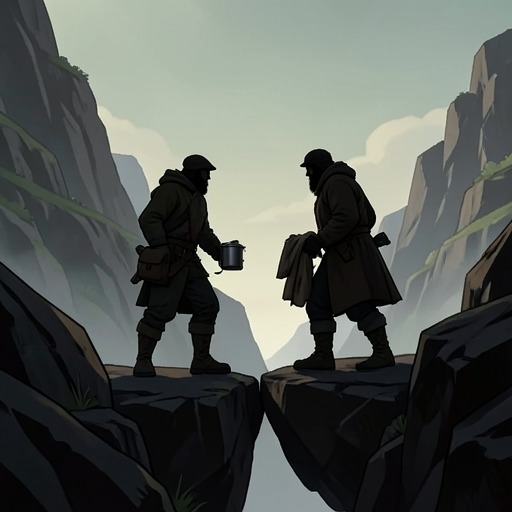
Attempt to stop and kill Shevek at the Port of Anarres
The DispossessedAt the Port of Anarres, a crowd assembles as Shevek prepares to leave for Urras aboard the freighter Mindful. Some intend to kill him as a traitor; others hope to prevent his departure, insult him, or simply see him. Their effort to stop him becomes a confused pursuit rather than an organized attack: Shevek reaches the ship, the crowd disperses, and a Defense crew member is killed by a thrown stone. The failed attempt makes the port wall’s political meaning immediate: the boundary that has kept Anarres apart from other worlds is also the threshold Shevek must cross, and the society’s commitment to uncoerced association does not prevent its members from turning against him.
The port as a boundary
The port occupies a barren sixty-acre field enclosed by a low wall of roughly mortared, uncut rock. The wall has no gate in the roadway, only a line that marks a boundary; physically easy to climb, it nevertheless carries the weight of seven generations. From one side, it encloses cranes, a rocket pad, warehouses, a truck garage, and a grim, uninhabited-looking dormitory. The facility is also a quarantine: it shuts in the ships and their crews, the worlds they come from, and the wider universe, leaving Anarres outside. The crowd’s arrival transforms this abstract separation into a contested place. People cross the road and some enter the walled field, while the freighter waits to carry Shevek through the boundary.
The Defense crew’s foreman had not expected the crowd to do anything. The captain of the Mindful sees it and asks whether it is after his ship; the foreman explains, in limited Iotic, that the protest concerns the passenger. The captain dismisses the possibility that the unarmed crowd can interfere and orders his crew to finish unloading, secure Shevek, and prepare for an earlier departure. His confidence in the weapon at his belt contrasts with the foreman’s practical authority: she gives the departure schedule, tells the crew to remain safe, and orders the roadway cleared so trucks can pass.
A crowd divided against itself
The crowd does not act as a unified body. Its members argue with the foreman and with one another, repeatedly crossing the roadway; nonetheless, they more or less clear it. They are accustomed to being members of a community, not components of a collective moved by a single mass feeling. Each person arrives with a different intention, and the group has little experience either in commanding a mob or in disobeying commands treated as reasonable. That inexperience, rather than a coordinated defense plan, helps Shevek get away.
Those who mean to kill him have no firearms, and the crowd’s idea of assault is direct physical attack. They expect Shevek to arrive under guard in a vehicle and turn their attention to a goods truck, inspecting it while arguing with its angry driver. But Shevek comes on foot, alone, with five Defense syndics following him. By the time the attackers recognize him, he has crossed half the field. Their pursuit comes too late; they throw rocks as he reaches the ship. The crowd’s incompatible purposes have obstructed the attackers’ brief route to him, even as the gathering itself creates the danger.
Escape and immediate cost
The stones barely strike Shevek, but one flint weighing two pounds hits a Defense crew member in the head and kills him. The ship’s hatches close. The Defense crew carries their dead companion away and makes no effort to stop the crowd’s leaders as they rush toward the freighter. The foreman, shocked and furious, curses at them; they swerve around her rather than confronting her.
At the ship, the crowd’s forward rush falters. The unfamiliar scale and machinery of the landing field disorient them, and a burst of steam or gas and a distant warning siren prompt unease. One person starts back toward the gate, then another; within ten minutes the field is clear and the crowd has scattered along the road to Abbenay. The scene’s outward ending is almost an erasure: from a distance, it seems that nothing happened. But the fatality and Shevek’s escape make that appearance deceptive. The attempt has failed to keep him on Anarres, while leaving a death in its wake.
Political meaning and aftermath
The assault exposes a conflict between the crowd’s varied judgments of Shevek and the freedom his departure represents. Some regard him as a traitor; others want to stop him leaving without seeking his death. The crowd has no single authority to settle those differences, and no common plan emerges from them. Its disorder both protects Shevek and makes violence possible. The episode thus gives concrete force to the novel’s contrast between voluntary community and organized coercion: the people do not move as a disciplined mob, yet the absence of that discipline cannot guarantee safety or prevent a fatal act.
The port wall’s two-sided meaning also frames the attempt. It is not simply a barrier protecting Anarres from the outside; it is the boundary at which Anarres tries to determine who may leave and what contact with other worlds means. Years later, the Settlement’s closure terms are invoked in discussion of return: nobody may leave a freight ship beyond the Port of Anarres boundary, and the dispute turns on whether that restriction applies to Anarresti as well as Urrasti. The rules make the port more than a setting for Shevek’s departure. It is a point where isolation becomes policy and where the possibility of crossing it carries political consequences.
The later violence in Urras sharpens the contrast without making the port incident identical to it. At Capitol Square, a vast organized demonstration is met by machine-gun fire from police helicopters; the crowd’s shared suffering and public speech are overtaken by state violence. The attack at the Port of Anarres is smaller, decentralized, and aimed at one departing person, but it likewise reveals how quickly political opposition can threaten bodies and lives. The ambassador from Terra later interprets the Nio uprising as a challenge to power rooted in the same libertarian tradition associated with Anarres. Against that broader history, the failed attempt at the port marks the cost of a society’s isolation and the danger of treating dissent or departure as betrayal.